
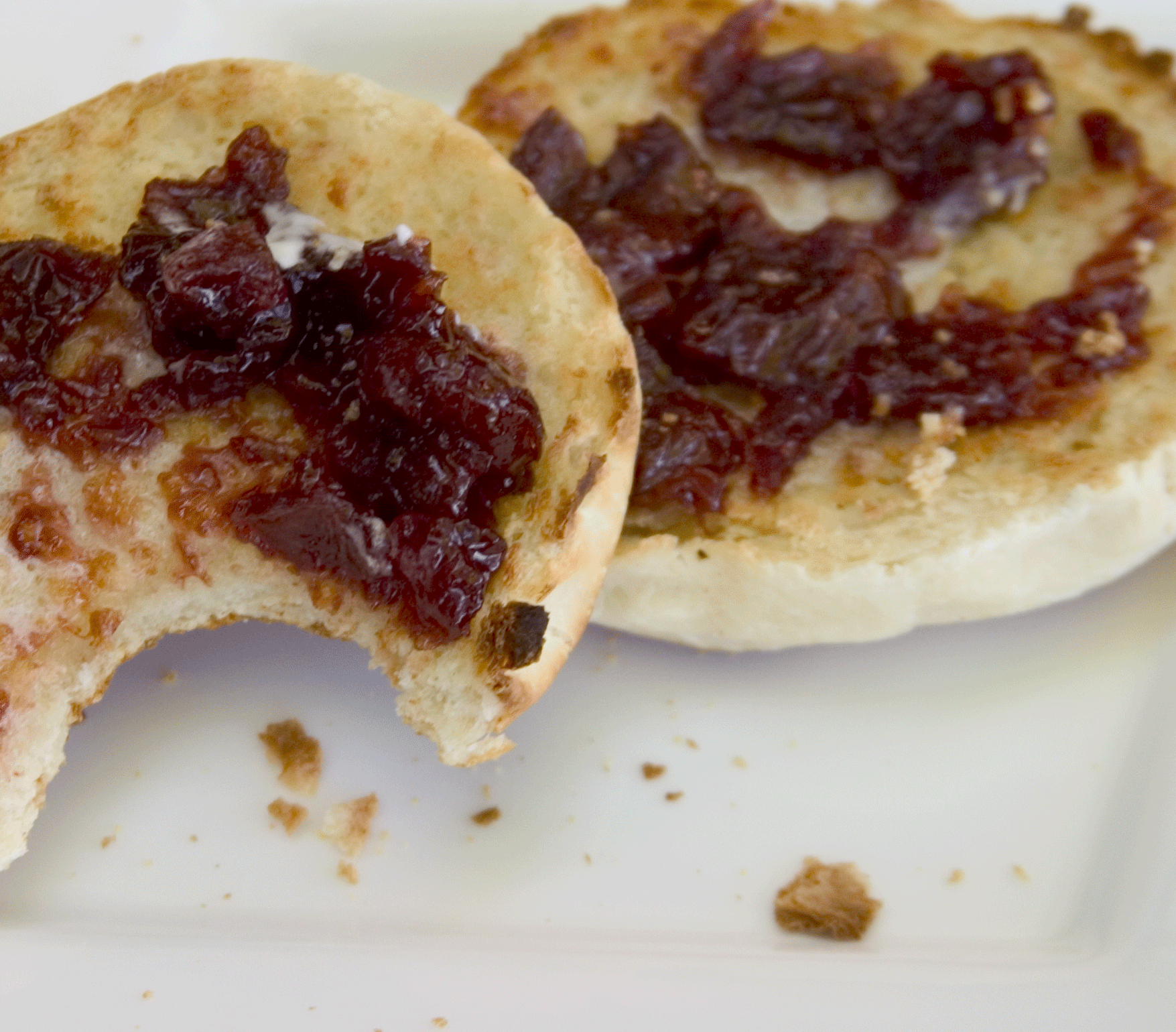
In week 12 of the Bread Baker’s Apprentice Challenge we visit English Muffins. I have long been a fan of Thomas’ english muffins, famous for their nooks and crannies, which are excellent at storing lots of melted salted butter. I figured that homemade english muffins would beat the Thomas’ version hands down. Peter Reinhart promised big holes, like the professionals get, if we can work with the soft dough and grill them at just the right time, catching them on the rise. I was up for the challenge.
This dough came together very easily, but I have to admit I was surprised that the recipe only makes 6 english muffins. All the other recipes from the book have yielded gargantuan breads. The dry ingredients, (bread flour, sugar, salt and yeast) are mixed with a bit of butter and some milk and kneaded in the mixer for about 8-10 minutes. Then the dough is set aside to ferment, until it doubles in size, about 60-90 minutes.

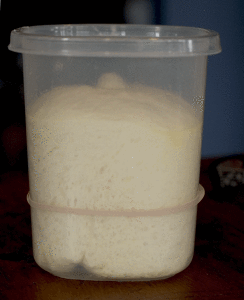
It was a very warm day and as usual, I was multi-tasking and didn’t quite catch the dough at the ” just doubled” stage. It looks like it tripled! Oh well, no harm done, or so I innocently thought. I weighed the dough and divided it into 6 equal pieces, and formed the little boules.
The balls of dough are then lightly oiled and sprinkled with cornmeal, covered with plastic wrap and left to rest until nearly doubled in size. I have to admit, this was an instruction I struggled with. I had a really hard time knowing when they were nearly doubled.
It reminded me of going to the optometrist and getting your eyes examined. My very first optometrist was my dad. He’d put those lenses in front of my eyes and say, “Is this better, or is this better?”, while he changed the magnification only infinitesimally. I could never tell which one was better but I was always too embarrassed to say so. Truthfully, I just thought he didn’t know what he was doing but I never wanted to make him feel bad, so I just lied and picked one. It was only after he died, and I had to go to another optometrist that I realized that my dad wasn’t a bad optometrist after all. I experienced this inability to tell the difference at my new optometrist too. Sorry dad, it was me not you!!
Now you look at these two pictures and see if you can tell if they are nearly doubled in size. The one on top is just after I formed the boules and the one below is after 90 minutes of proofing, when I figured that, they looked almost doubled.


Then it was time to cook the muffins. English muffins are baked in a frying pan or cooked on a griddle and then finished in the oven. I gently transferred them to the pan and cooked the first side over medium heat for about 5 minutes until they were golden brown. They are supposed to spread out on their own but mine still looked like little balls so I helped matters along and squished them gently with a spatula. Then I flipped them over and cooked the second side.

Once the second side was done they went into a preheated oven for an additional 5 minutes, to finish cooking the inside. After letting them cool for 30 minutes, we split them open with a fork. Fork splitting, apparently gives english muffins their characteristic nooks and crannies. The moment of truth…


Even with the fork splitting, the nooks and crannies were absent. I’m not quite sure where I went wrong. I suspect that I over fermented (first rising) as well as over proofed (second rising) them. Peter Reinhart says that if you catch them “on the rise” you will be rewarded with the nooks and crannies. I think my muffins went past the rise and I missed my opportunity. I also suspect that since my little balls did not spread out on their own, that my dough was not wet enough and if there were any air holes inside, I may have squished them when I pressed down with my spatula. However, I toasted them and slathered them with salted butter and American Spoon sour cherry preserves and they were very tasty, but not as good as Thomas’.
Although I was a little disappointed with the results, it was still a worthwhile exercise as I was reminded the other day of one of the reasons I began this challenge. I was reading a book review of Marion Cunningham’s “The Breakfast Book” on epicurious.com. In the book Marion says, “Cooking is one of the legacies we can leave to the future, and I would like to be remembered for my baking. We all know we’re not immortal, but after I’m gone, I would like my son and daughter to be able to say, ‘Our mother made real yeast bread for breakfast.” I couldn’t have said it better myself!
P.S. My sons and daughter loved the english muffins.